Air Cannon Experimentation Variables
Finding the Best Launch Angle
Goal
Test how launch angles affect projectile distance using scientific method, making predictions and collecting data.
Steps
Make Predictions:
- Discuss which angle you think will achieve maximum distance
- Explain your reasoning
Plan Experiment:
- Select specific angles to test (low/medium/high)
- Determine number of trials per angle
- Keep all other variables constant
Collect Data:
- Measure angles precisely
- Record distances in your data table
- Complete multiple trials for reliability
Reflect: Compare results to your initial prediction and explain why angle affects distance
Use this sheet to collect your data
Projectile Properties & Data Visualization
Purpose
Test how different projectiles affect flight performance and learn to create graphs that reveal patterns in your collected data.
Activity Steps
Select Test Projectiles:
- Brainstorm safe, cannon-compatible alternatives to the foam ball
- Choose 1-2 different projectiles for comparative testing
Design Fair Experiments:
- Maintain consistent variables (same pressure and angle) for valid comparisons
- Record distance measurements for each projectile type
Create Data Visualizations:
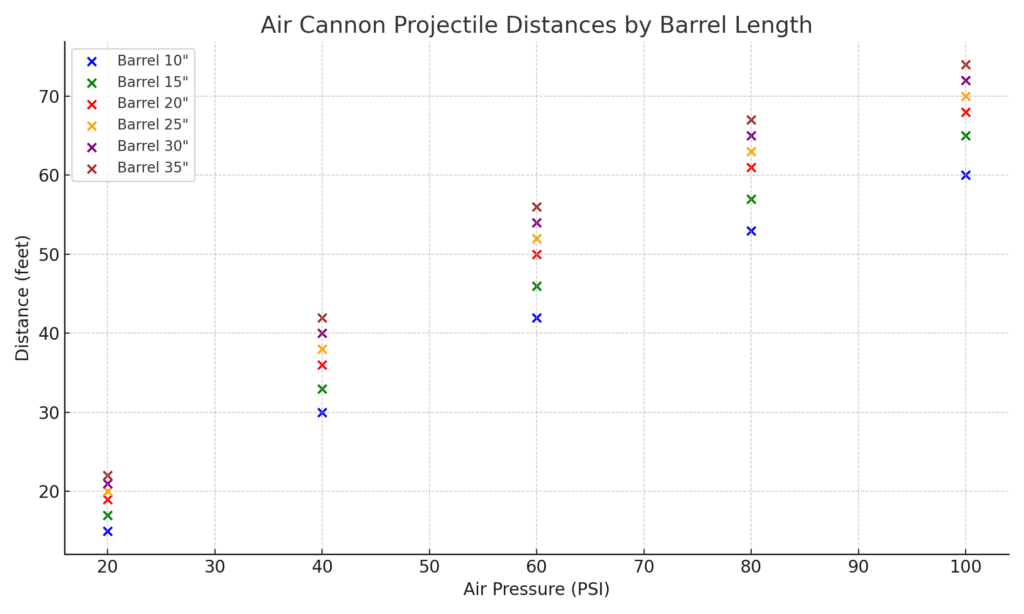
- Learn to make a scatter plot using your angle vs. distance data
- Analyze your graph to identify patterns and relationships
Extension: Design your own custom projectiles using simple materials to explore how shape influences flight characteristics.
Video Analysis for Measuring Projectile Speed
Purpose
You’ll use slow-motion video with a measurement grid to calculate your projectile’s velocity, then analyze all collected data to draw meaningful conclusions about your air cannon’s performance.
Activity Steps
Setup the Timing Grid: Position the 1-inch striped backdrop behind your launch area
Record in Slow-Motion: Capture several launches at specific pressure/angle settings
Video Analysis:
- Measure distance traveled (in grid stripes/inches)
- Count frames it takes to travel that distance
- Note your phone’s slow-motion frame rate (fps)
Calculate Velocity: Average Velocity = Distance Traveled ÷ Time Elapsed Time Elapsed = Number of Frames ÷ Slow-Motion FPS
Analyze All Data:
- Examine relationships between pressure, barrel length, angle, projectile type, distance, and velocity
- Identify which factors most significantly impact performance
- Consider measurement challenges and their effects on accuracy
- Alternative: use the FizziQ app to calculate the velocity.
Discussion Point
How do scientists and engineers use similar video analysis techniques to study motion in professional settings?
Air Cannon Challenge: Mastering Projectile Motion Phet Simulation
Objective: Explore how different factors affect the path of a projectile and discover how to accurately hit a target, just like a real air cannon!
Materials:
Computer or tablet with internet access
Access to the PhET Projectile Motion simulation: https://phet.colorado.edu/en/simulations/projectile-motion
Let’s Get Started!
Open the Simulation: Click the link above to open the PhET Projectile Motion simulation.
Go to the “Lab” Tab: Select the “Lab” tab. This is where you can freely experiment!
Your Challenge: Hit the Target!
Imagine your air cannon needs to hit a specific target. Use the simulation to find the best way to do this.
Set Up Your Scenario:
Drag the target (the yellow circle) to a distance of your choice.
Choose a projectile (e.g., a cannonball or pumpkin).
Experiment and Explore:
Initial Speed: How does changing the initial speed (velocity) affect how far your projectile travels?
Launch Angle: What happens when you change the launch angle? Can you hit the same target with different angles?
Mass & Diameter: Do the mass or diameter of the projectile change anything? Try turning air resistance OFF and then ON to see the effect.
Air Resistance: How much does air resistance impact your shot? When is it most noticeable?
Record and Analyze:
Try to hit your chosen target several times, adjusting only one variable at a time (e.g., keep angle and speed constant, only change mass).
What combination of settings gets you closest to the target?
Use the measuring tape to precisely record the range and height of your shots.
Think & Discuss:
What did you find to be the most important factors for hitting your target?
How do these discoveries relate to designing and using a real air cannon?
If you had to redesign your air cannon, what would be your top three considerations based on this simulation?
Present your findings on the Padlet below: