Space Science :: Rockets
Now that you’ve watched the videos and learned about how things move in space, here’s a quick summary of how Newton’s Laws apply to building rockets. Newton’s Laws explain how rockets move:
- The first law says a rocket will stay still or keep moving unless a force acts on it.
- The second law shows that more force (like more air pressure) makes a rocket speed up more.
- The third law—for every action there’s an equal and opposite reaction—is what launches your rocket: the air pushes out one way, and the rocket goes the other.
Understanding Newton’s Laws will help you design rockets that actually work.
Paper Stomp 🚀 Instructions
🎯 Objective:
Design, build, and launch paper stomp rockets, learning about aerodynamics, engineering, and the current space race! 🚀🌎
🛠️ Step 1: Gather Materials
✅ Paper or cardstock 📜
✅ Tape 🎗️
✅ Scissors ✂️
✅ Fuselage rolling template 🏗️
✅ Markers for decoration 🖍️✨
✅ Stomp rocket launcher 🦶💨
🛠️ Step 2: Building the Rocket
Create the Rocket Body: 🏗️
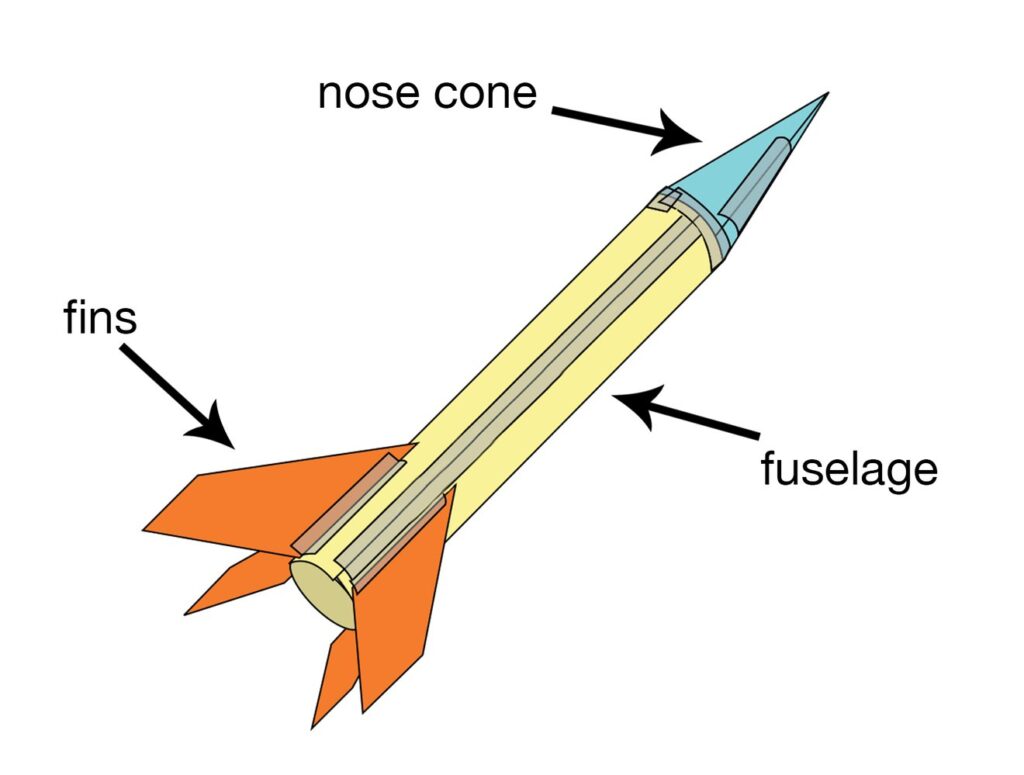
- Wrap a piece of paper or cardstock around the template to form a tube.
- Tape the edges securely and slide it off the template.
Design the Nose Cone: 🔼
- Cut a small circle of paper, cut a slit to the center, and overlap the edges to form a cone.
- Tape the cone to one end of the rocket body.
Attach Fins for Stability: 📏
- Cut three or four fins from cardstock or paper and attach them symmetrically near the open end of the rocket.
- This helps the rocket fly straight and increases stability.
Decorate (Optional): 🎨
- Use markers, or colored paper to personalize your rocket!
🚀 Step 3: Launch Preparation
Set Up the Stomp Rocket Launcher: 🦶
- Place the launcher in an open space, free from obstacles.
- Insert your rocket onto the launcher tube.
Get Ready to Launch: 📏
- Stand back, aim your rocket at the target, and prepare to stomp!
🚀 Step 4: Launching the Rocket
STOMP! 👣💥
- Stomp on the airbag to propel your rocket into the air!
- Observe its flight path—did it go straight? How high did it go?
Experiment & Improve: 🛠️
- Adjust the fins, nose cone, or rocket length to see how it affects the flight.
- Try different angles of launch for distance vs. height.
🌎 Current Space Race 🛰️
🚀 NASA Artemis Missions: Returning humans to the Moon for exploration and research. 🌕
🚀 SpaceX & Starship: Developing reusable rockets for deep space travel. 🌍🚀
🚀 Mars Exploration: Perseverance rover is searching for signs of life! 🔴
🚀 Satellite Mega-Constellations: Starlink is changing global internet. 📡
🚀 Commercial Space Travel: Companies like Blue Origin & Virgin Galactic offer private spaceflights! 🛰️
🚀 Lunar & Martian Habitats: Future plans for sustainable living on the Moon & Mars. 🏠
These innovations make space more accessible and exciting than ever before—and you could be part of it!
🌠 Careers in the Space Industry
Interested in space and rockets? There are many exciting career paths beyond being an astronaut!
- Aerospace Engineer – Designs and tests rockets and spacecraft. 🛰️
- Propulsion Engineer – Develops rocket engines and fuel systems. 🔥
- Avionics Technician – Works on electronic systems for spacecraft. ⚡
- Robotics Engineer – Designs robots for space exploration. 🤖
- Satellite Engineer – Develops and maintains satellites. 🛰️
- Mission Planner – Strategizes space missions and orbital paths. 🗺️
- Space Weather Scientist – Studies solar flares and their impact. 🌞
- Data Analyst (Space Data) – Interprets satellite and mission data. 📊
- Astrobiologist – Researches life in extreme environments. 🧬
- Space Lawyer – Handles regulations and legal issues in space. ⚖️
- Orbital Mechanic – Plans spacecraft movement and docking. 🛠️
- Materials Scientist – Develops heat-resistant and lightweight materials. 🔬
- Astronomer – Studies celestial bodies and cosmic phenomena. 🔭
- Planetary Geologist – Analyzes planetary surfaces and landscapes. 🪨
- Space Medicine Specialist – Researches human health in space. 🏥
- Ground Systems Engineer – Manages communication with spacecraft. 📡
- 3D Printing Specialist – Creates space tools and habitats with 3D printing. 🖨️
- AI and Machine Learning Scientist – Develops AI for autonomous space missions. 🤖
- Cybersecurity Expert – Protects space systems from hacking threats. 🔐
- Thermal Engineer – Designs temperature control systems for spacecraft. 🌡️
- Payload Specialist – Ensures scientific equipment is safely transported. 🎛️
- VR/AR Developer – Creates virtual space training simulations. 🕶️
- Science Communicator – Explains space science to the public. 🗣️
- Space Tourism Developer – Works on future commercial space travel. ✈️
- Lunar or Mars Habitat Designer – Plans space colonies and habitats. 🏠
🚀 Which of these careers excites you the most? Keep exploring and reach for the stars! 🌟

🛰️ Scoring System: Flight Performance & Challenges
🚀 1. Flight Performance Points
| Flight Achievement | Points |
|---|---|
| Rocket flies straight and stable | +3 |
| Rocket reaches high altitude (top 30% of launches) | +3 |
| Rocket shows a creative or innovative design | +2 |
🌍 2. Planetary Landing Points
| Landing Location | Points |
|---|---|
| Lands on a planet | +5 |
| Lands within 1 foot of a planet | +4 |
| Lands within 2-3 feet of a planet | +3 |
| Misses all planets but lands in space | +1 |
| Crashes back on Earth (falls near launch area) | -10 |
🌀 3. Bonus Challenges
| Challenge Completed | Points |
|---|---|
| Passes through the hula hoop (simulating orbital insertion) | +4 |
| Flies over the entire solar system (longest distance) | +3 |
| Closest landing to a selected deep-space target (Jupiter, Saturn, etc.) | +3 |
🏆 Final Score & Awards
At the end of the competition, total up your points. Award categories include:
🏅 Best Overall Rocket (highest score)
🏅 Best Flight Stability (highest flight performance points)
🏅 Most Accurate Landing (closest to target planets)
🏅 Best Engineering Design (creative or innovative rocket) 🚀