
Space Science :: Space Rovers
🚀 Mars Rover Exploration
Your Mission
Your engineering team is tasked with designing and building a prototype rover using a limited set of materials. This rover must be powerful enough to move on its own and tough enough to cross a simulated Martian landscape with different terrains. You will build, test, analyze, and improve your design—just like real NASA engineers.
What is Regolith?
Spring Tire Rover Wheels
Modern Mars Rover Wheels
Rover Wheel Testing
Want more? Explore NASA Wheels here
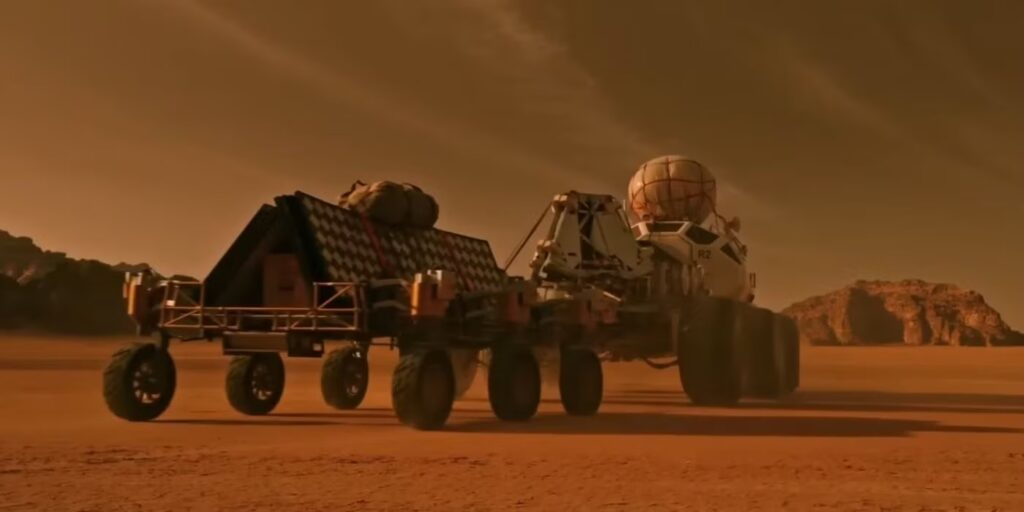
The movie The Martian starring Matt Damon’s Mars rover with trailer
Phase 1: Rover Construction
Using the materials provided, construct your initial rover prototype. The basic design will use a rubber band to store potential energy, which transforms into the kinetic energy that moves the rover.
- Build the Rover Body: Cut a 15×15 cm piece of cardboard and fold it into thirds.
- Create the Axles: Poke holes for a front and back axle. Use a straw for the front axle and a pencil for the back axle.
- Attach the Wheels: Cut four 10 cm cardboard circles and tape them to the ends of the axles. For your wheels to spin well, you need to minimize the friction between the axles and the axle holes.
- Install the Power System: Create an “axle hook” from a paperclip on the back axle. Attach linked rubber bands from the front of the rover to this hook.
- Power Up: Wind the back axle to tighten the rubber band.
Phase 2: Martian Terrain Test
It’s time to see how your prototype performs. Your testing ground is a simulated Martian landscape. Place your rover at the start line, wind it up, and release! Observe how it performs!
Record your observations:
- Did your rover get stuck? If so, where?
- Did the wheels spin without moving forward? This “spinout” happens when the wheels can’t get a grip, or traction, on the surface.
- How far did your rover travel?
Phase 3: Analyze and Re-Engineer
Real missions can be jeopardized by mechanical issues or wheel failures. Based on your test data, it’s time to improve your design. Discuss with your team what worked and what didn’t.
Engineering Questions:
- Traction Control: If your wheels spun out in the dust or sand, how can you increase traction?
- Could you make the wheels thicker or add more wheels?
- NASA’s Perseverance rover has wheels made of aluminum with special treads, or grousers, to grip the surface. How could you add “treads” to your cardboard wheels?
- Would adding weight over the back axle help?
- Wheel Design: The Perseverance’s wheels are larger in diameter than previous rovers. How would making your wheels bigger change your rover’s performance? What about different shapes?
- Power Management: Was your rover too powerful and uncontrollable? Try adding more rubber bands to the link or cutting the band to create a single strand to reduce tension.
Modify your rover based on your new ideas. Then, run it through the Martian terrain again to see if your changes resulted in a successful mission!
Early Moon Rover Wheel Tests

1960’s Prototype wheels made by GM, DRL, and Goodyear for SLRV. Courtesy of Dave Glemming.

Various small scale lunar vehicles with articulated frames and unconventional running gear (Bekker 1962, Bekker 1963). The vehicle on the left has high width to diameter wheel ratio, the middle vehicle uses screw propulsion, and the right vehicle has spaced link tracks. Courtesy of Don Freidman.
🧪 Science Connection: Material Science in Space
In space exploration, choosing the right materials is critical: 🧬
Rovers need flexible yet durable tires that can survive freezing temperatures, dust storms, and sharp rocks. ❄️🌪️
Materials like aluminum alloys, titanium, and carbon fiber are often used for strength and weight balance. 🛠️
Engineers must test materials in vacuum chambers and cold rooms to simulate space. 🌡️🌌
💭 Questions:
What material properties did you look for when choosing your design materials? 🤓
How do your design choices reflect what real scientists must consider? 🧑🔬
🚀 Careers That Explore Beyond Earth
Interested in helping build the next rover? These careers make it happen: 🌟
Robotics Engineer – Designs and builds robotic systems like Sphero or Perseverance 🤖
Mechanical Engineer – Specializes in treads, wheels, and motors for movement 🔧
Planetary Geologist – Studies Moon and Mars surfaces to help pick landing sites 🌍🪐
Material Scientist – Develops space-grade materials for harsh environments 🧪🔬
Aerospace Technician – Builds and tests components of real spacecraft and rovers 🛠️🚀
✨ Wrap-Up & Reflection
🏆 Which tread designs worked best and why?
🚧 What real-world challenges did this activity help you understand?
🔁 How did you iterate on your ideas to improve them?


Rover Music
How do you build a Mars Rover?
Resource Links:
VIPER
The Lunar Lab and Regolith Testbeds
https://ntrs.nasa.gov/citations/20100000019
https://www3.nasa.gov/specials/wheels/